
Live and Let Live
A Simple Model of Memes

Welcome to the Gnostic Reformation. My name is Dr. Cyd Ropp and I'm your host. Today I am going to read you a chapter out of my book, A Simple Explanation of Absolutely Everything. And today we are going to speak about my simple model of memes.
Memes are the cultural expressions of societies, and their content is information. In human societies, memes are often propagated through mass media such as magazines, films, and the internet, in addition to word of mouth and tradition. Every discrete concept, mythology, or icon is a meme. “The Beatles” is a meme. Andy Warhol’s iconic poster of Marilyn Monroe is a meme. Football is a meme. Patriotism is a meme—all “ism”s are memes. “The Cross” and “The Crescent” are memes. “Loyalty” and “Honesty” are memes. Indeed, each and every particular idea that a person can know is a meme. Even basic concepts like “chair” and “mother” are memes. Memes, in other words, are the “stuff” of symbolic thought.
Some memes are held in common by most human cultures—the wheel; the ideal model of a caring family; archetypal heroes and villains like the Wise Sage and the Shadow; even universal human values such as liberty and safety. Other memes are exclusive to their particular culture. This especially applies to memes dealing with local traditions, religions, politics, and regional myths.
Humans are not the only units of consciousness affected by memes. All social aggregations of UCs propagate and utilize memes. Cats, for example, bury their waste because there is a strong waste-burying meme that resonates in all cats. “Dog is man’s best friend” is a shared meme chord continually re-propagated and reenacted by both humans and dogs. “Flying in formation is awesome” may well be a goose meme.
Memes can be described as energetic waves of cultural information patterns fueled by repetition or starved by lack of usage. As wave forms, each meme has a distinct vibratory signature, akin to a musical note. Each individual meme can be likened to a string on society’s harp. A single meme is like a single note. A group of related memes is like a chord.
If, for example, we look at the meme chord for "America," we can quickly list a variety of memes and complex sets of memes that contribute to that chord: Constitutional government; the Old West; Consumerism; Slavery and emancipation; American politics; Elections; Liberty; Capitalism; the Founding Fathers; Hollywood movies and television; Justice; Popular music; Baseball; and so on with all other memes associated with “America.”
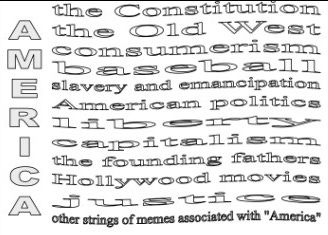
Each meme chord vibrates to the particular concepts that make it up. UCs who share the same memes are like members of a choir cloaked in the robes of their common meme chords, all vibrating in unison with one another.
We are not all affected by the same memes. Most memes pass us by unnoticed. A meme must be either instinctually acquired (through prenatal karma) or learned in order to be invoked by a Unit of Consciousness. Once a UC does acquire a meme, it becomes a part of that UC’s unique vibratory bundle. If the UC does not wish to continue holding that meme’s string in its personal bundle of memes and chords, it must detach the string from its grasp.
Some memes are easy to detach because they do not fit in with the UC’s overall bundle of strings and chords. One may, for example, forget the details of a foreign film as soon as it is over because its memes do not bond well with the movie-goer’s personal meme bundle. Some memes are very difficult to detach once they are acquired because their vibratory pattern is so intense. Emotionally evocative memes such as victimhood, shame, or jealousy are difficult to detach due to the intense synergistic coupling of thoughts and emotion. Post Traumatic Stress Disorder is one such condition that bonds unwanted memes with crippling emotion. Addictions, likewise, tightly cement their disabling meme bundles onto the addict’s ego.
A Unit of Consciousness may pick up entire chords of associated memes, but it is also common to pick and choose from among a chord’s individual strings.
“Happy Marriage,” for example, is a complex meme chord that means different things to different people, depending upon their personal selection of particular strings. One prospective couple may resonate to the “Big Wedding” meme and so expect to invoke that meme at the outset of the Happy Marriage. Another couple may not be holding on to that memetic string and so do not need or want a big wedding. For most couples, the Happy Marriage chord includes children; other couples do not resonate to the offspring meme, so no children are necessary. For many couples, the “Bouncing Baby” meme may be adequately invoked by the “Man’s Best Friend” dog meme. So, while we all have an idea of what “Happy Marriage” means, we each hold a slightly different set of memes that define it. But the bottom line to marital bliss must begin with a couple’s shared and harmonious meme chords.
The importance of memes to the Simple Explanation philosophy is that a huge part of our personality is shaped by the memes we collect and hold onto. The otherwise pristine nature of our underlying fractal Unit of Consciousness is affected by the memes we hold dear, as well as the memes we despise. We enjoy memes we approve of and we are repelled by memes we disapprove of. The Sanskrit word for these provocative memes is “samskara.” Samskara is traditionally defined in Yogic philosophy as the habitual thought patterns collected by the ego that interfere with soul consciousness.
The memes each of us cling to, both those we like and those we actively dislike, influence our ability to exercise free will in the here and now. When we unthinkingly lock onto a meme or set of memes, it is our belief in those memes that determines how we interpret and respond to our surroundings. Our response may or may not be the best response to a given situation, but it is the only response allowed for by our particular meme bundle. In other words, our meme bundles function as incoming and outgoing filters.
Literary theorist and philosopher Kenneth Burke called this meme filter a “terministic screen” situated between each person and reality, both selecting and deflecting their perception of the world. Burke said this terministic screen was activated during information exchanges with others and within oneself during self-talk. The filter of our terministic screen blocks unacceptable memes from affecting our comfortable perception of reality.
We see the terministic screen at play every day on the interpersonal level. For example, Person A, whose meme bundle includes a belief that others are "out to get me," will interpret events in a manner that reinforces that meme. The most innocent statement on Person B’s part will activate Person A's "out to get me" meme, even when no such insult was intended or even imagined by Person B. Clearly, Person A’s own meme attachment hurt Person A, not Person B.
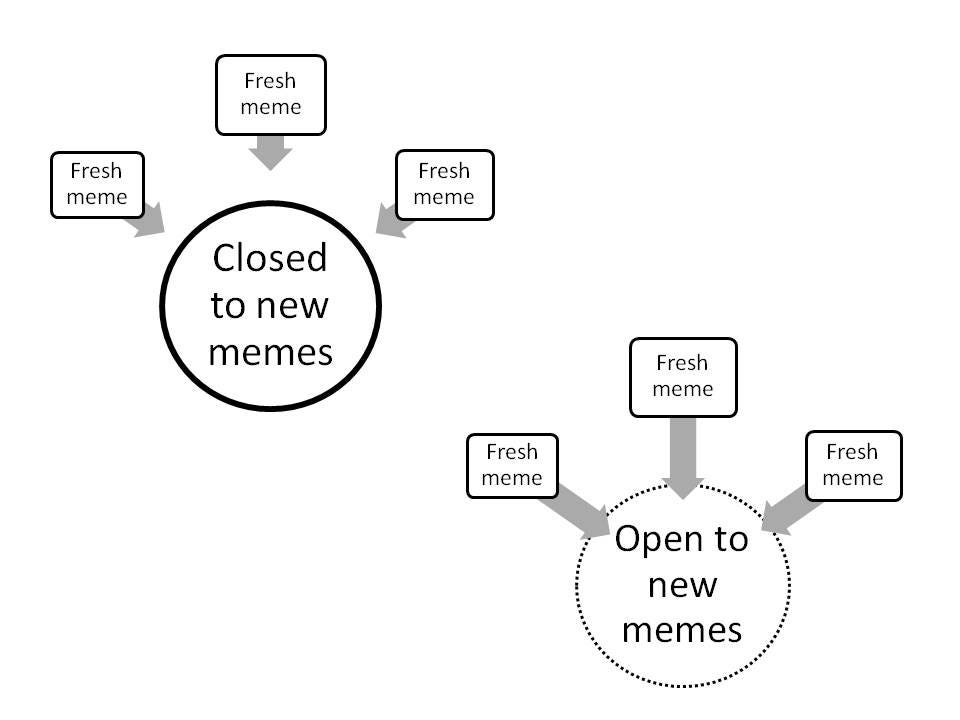
The same meme-filtering mechanism holds true for groups in the form of cultural ideologies, complex bundles of memes shared by members of a group. What is and isn’t allowed in the minds of members is determined by which memes are included and which are excluded from the group’s ideological meme chord. Because of this, information exchanged between members of different cultures will resonate more strongly with the sender’s memes than with the receiver’s memes. For example, when an American speaks of “free and democratic elections,” his or her memetic definitions for “free” and “democratic” may differ radically from another’s culture. The extent to which communication may occur between cultures is determined by their overlapping memes and the permeability of each culture’s terministic screens and the extent to which they are open to foreign memes.
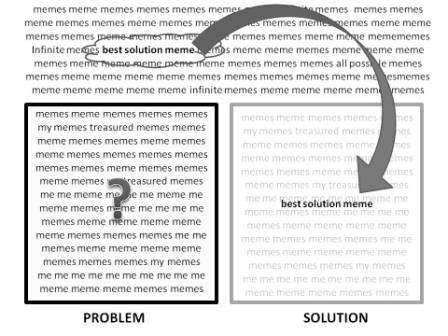
Another example of delimiting memes occurs during problem-solving. The more tightly held one's memes are, the fewer solutions will present themselves. If you think only a hammer will drive a nail, you will not even consider the flat side of the heavy wrench lying nearby. If a group thinks outsiders are untrustworthy, then they will not trust any outsider. The ability to consider solutions "outside the box" and to engage in "lateral thinking" comes about through nonattachment to the "shoulds" and "oughts" of how things work. One must be willing to set aside treasured beliefs in order to perceive memes outside one's own bundle and thereby discover fresh solutions.
Institutional Memes
As an individual UC’s personality is defined by its unique meme bundle, institutions are also defined by their sets of treasured memes. Memes are even more important to an institution than are its members in the sense that members come and go, but memes persist. As President John F. Kennedy put it, “People may die, nations may rise and fall, but an idea lives on.”
Each and every cultural institution we belong to (family, workplace, church, mosque, tribe, nation, and so on) not only comes with its own bundle of shared memes held in common by its members, it also comes with a filter, Burke’s terministic screen, that limits members from acknowledging or adopting ideologically incompatible memes.
Institutions are defined as much by their excluded memes as they are by their included memes. An exclusive institution holds tightly to the identity provided by its current memes; its border is strong and its filter is powerful. An inclusive institution allows members more latitude in the memes they may hold--its border is less defended, its filter less opaque. An "open-minded" institution allows that there may be memes out there in the larger culture of value; its filter is more permeable.
Conservative institutions hold tightly onto their memes, which are usually formally codified into law. Whether embodied in the rulings of a Supreme Court or issued by a Tribal Chief, these reckoning rods declare the boundaries of the institution’s acceptable memes and are the mirrors by which members define themselves as part of this group rather than that.
Progressive institutions, on the other hand, hold an overarching “inclusive” meme that requires an open and permeable meme boundary that can accommodate diversity of thought and expression. Because of this inclusivity value, open institutions look to their members as living sources of shared memes in preference to codified documents or singular authority figures. (The definition of progressive has recently shifted away from true inclusivity and diversity as those memes have undergone a radical language alteration.)
President Kennedy presents a good example of a politician formally considered progressive who valued others’ memes, as the following quotes reveal.
“As every past generation has had to disenthrall itself from an inheritance of truisms and stereotypes, so in our time we must move on from the reassuring repetition of stale phrases to a new, difficult but essential confrontation with reality.
“For the great enemy of the truth is very often not the lie—deliberate, contrived and dishonest— but the myth—persistent, persuasive, and unrealistic. Too often we hold fast to the clichés of our forebears. We subject all facts to a prefabricated set of interpretations. We enjoy the comfort of opinion without the discomfort of thought.”
John F. Kennedy’s Yale University commencement address (New Haven, Connecticut: June 11, 1962)
“We are not afraid to entrust the American people with unpleasant facts, foreign ideas, alien philosophies, and competitive values. For a nation that is afraid to let its people judge the truth and falsehood in an open market is a nation that is afraid of its people.”
“What is objectionable, what is dangerous about extremists is not that they are extreme, but that they are intolerant. The evil is not what they say about their cause, but what they say about their opponents.”
John F. Kennedy
Transpersonal Memory and Morphogenetic Fields
Let’s see how this meme model can help visualize and explain a couple of puzzling theories.
Transpersonal memory is defined as memories that are shared at a cultural level, rather than as personal memories. Transpersonal memories reveal themselves in many ways, through societal archetypes and archetypal dreams, through sub-conscious assumptions, stereotypes, and expectations, and through strange occurrences such as the purported "100th Monkey" phenomenon. C.G. Jung referred to this transpersonal memory as the collective unconscious. The Simple Explanation identifies these transpersonal memories as collective memes and meme chords and locates them at the level of our aggregate consciousness—they constitute the mind of the culture’s UC.
Biologist Rupert Sheldrake has written extensively about a scientifically-controversial process he calls morphogenetic fields. How does an oak tree develop from an acorn? By information carried in the morphogenetic field surrounding the acorn. Sheldrake explains that morphogenetic fields are to life-forms what quantum probability clouds are to sub-atomic particles, carrying the information that gives rise to particular biological manifestations of form.
The Simple Explanation would site these morphogenetic fields at the center of the torus associated with the acorn’s UC. In the case of the acorn and the oak tree, the morphogenetic field of the oak tree provides the genetic blueprint, while the mama tree's karma and memes provide the individualized epigenetic pattern that tells which genes to turn on and off. What karma can a tree have? Its karma is the record of its life--nutrients, weather, history of water availability, pest attacks, and so on. What memes can a tree hold? "The sun feels good on my leaves; must follow the sun."
The Simple Explanation agrees with Sheldrake that personal memories do not reside in the meat portion of our brains, but are vibratory patterns held in the zero-point field, as are Jung’s collective transpersonal memes. Furthermore, apparently personal memes are actually harmonics of collective memes and are shared in common with all who hold onto that meme. The particular shadings of one person's memes differs slightly from the next person's, as is to be expected among fractal replications of a single phenomenon, but all who hold a particular meme know its pattern and are affected by it.
When Meme Chords Collide
Meme chords can be incredibly complex, as is the case with religious meme chords and constitutional meme chords. Religious meme chords are codified in the Holy Book of the religion and taught to all believers. Violations of religious memes are called sins. Governmental meme chords are written as constitutions, laws, and court rulings, and all citizens are expected to learn them and obey. Violations of governmental memes are called crimes.
Academic meme chords represent the field of study. Accumulation of academic memes is what makes a person "educated." Scientific meme chords, for example, consist of the subject material of each scientific specialty--geology memes, astronomy memes, chemistry memes, and so on--plus the meme chord known as the scientific method that specifies how inquiries are to be handled and what constitutes "proof." Axioms, theorems, and proofs are memes. Violations of scientific and academic memes are considered to be either honest mistakes or academic fraud.
We like people who share the same memes we do. The more memes people have in common, they more they agree with each other, and the more they like and respect the other person. Friends have a lot of memes in common. Co-religionists share the same religious meme chords. Tribal brothers and sisters share tribal memes. Citizens share their nation's meme chords. Sub-cultures share their sub-culture's memes.
Some types of memes are more important than other types, and it's the important memes that matter most. If we agree on the meaning of the meme "justice," we can probably overlook disagreement over the meme of whether the toilet paper should go over or under the roll. Or maybe not.
What happens when meme chords collide? What happens when the memes I believe in and hold onto contradict the memes you hold dear? Herein lies the source of all human conflict. In Gnosticism we call this the Endless War. The disagreements, the fights, the wars, are all conflicts over incompatible memes.
I may believe that my memes are vastly superior to yours. Does that mean I should kill you? What a ridiculous idea. Oh, but what if I strongly believe my memes are the best, no doubt about it? Does that mean you have to believe every meme I believe or else I’m going to burn your house down and loot you business? How absurd. Yes, but what if I know in my heart that my memes are so much better than your memes? Does that mean you are stupid? Or systemically racist? Does that mean you are a fraud? Does that mean you just don't get it? Maybe, maybe not. Most of our memes came embedded in larger meme chords handed down by others. Most of us have no idea what meme chords we hold and how we came to hold them. In any case, you can't force someone else to adopt your memes, any more than you can force someone to adopt your gender or your skin color. It is an impossibility.
The Simple Explanation suggests that "live and let live" would be a great meta-meme for everyone to adopt. If we could appreciate the fact that each of us has a unique perspective, then perhaps we could allow each other to hold the memes that make the most sense for our own lives. This is my meme chord; that is your meme chord. If I don't like your meme chord then I can talk it over with you and see if we can move our meme chords closer together in agreement. If neither of us is willing or able to swap memes with the other, then so be it. Either accept the other person, memes and all, or move on. Find someone else who more closely agrees with your memes. There is enough room in this world for each of us to hold our own chords, but only if "live and let live" is an overarching meme.
“Live and Let Live” Is the Democratic Ideal
We are now in the midst of a social epidemic of intolerance. Intolerance is the opposite of "live and let live." When we are intolerant of others' memes, we are declaring that our memes are correct and their memes are wrong. And then we take it a step further--we refuse to "tolerate" the others' memes. We throw up resistance, we throw up roadblocks, we close our ears and refuse to listen to the other. We do not merely disagree, as reasonable people may do from time to time. When we are intolerant, we look for ways to force the other to abandon their memes and adopt ours. We shout them down because we feel we are shouting the right memes and theirs are not only wrong, they are evil and have no right to be heard. And once you declare the other "evil," it is no longer a disagreement in good faith, but a fight for the soul. "God is on our side, therefore we can do whatever it takes to crush the opposition!" That is a dangerous and usually delusional meme to hold. And if it entitles the holder to disregard rule of law, then it is not a democratic ideal and it has no place in American politics.
Once words can no longer be exchanged, frustration builds and violence follows. This is what we are seeing now, because free exchange of memes has been thwarted through intolerance.
Exchange of ideas is the key. You needn't agree with the other person, but you must hear them out. Because, once you agree to sit and exchange ideas and concerns, whether or not you adopt the other's ideas, the very act of hearing each other creates a shared space that acts as a balm to soothe both your soul and theirs. When you are too angry, frustrated, or afraid to listen to the other, you perpetuate the intolerance that leads to violence. This intolerance is not helpful.
We hear a lot about the importance of "diversity" nowadays in America. True diversity can only thrive if we allow each other to "live and let live." When you seek to silence those with whom you disagree, you are not encouraging diversity; you are actually partaking in, and dare I say it? fascism. Fascism advocates the forced suppression of those who express opposing views. Disagreement, on the other hand, is not forced suppression, it is merely disagreement. Shouting others down when they have the floor, shunning those with whom you disagree, unfriending people on facebook because they hold opposing views, refusing service in a restaurant to paying customers who voted for a different candidate, does not help us come together to make things better for the common good.
In Gnostic terms, this is a violation of the simple golden rule. It is a continuance of the Never Ending War. It engages the 2nd order powers in endless war, chasing each other like the ouroboros, which is the snake eating its own tail. It does not build, it merely enslaves.
OK, this is about half of the chapter on memes in A Simple Explanation of Absolutely Everything book. I will bring up Part 2 of memes in our next podcast. Part 2 has to do with exoteric and esoteric religious memes, and we will talk about religion, faith, and belief in terms of meme bundles. Thank you for spending this time with me. Onward and upward and God bless.
I moved and moved and traveled and traveled in life, first in a military family during the Vietnam War.
Somehow it has been easy for me to become broadly conversant in memes, which lets me have a substantive conversation with almost anybody. That's nice. Once people are conversing within a common context and not rejecting each other reflexively, they can communicate readily.
The average prosperity (not GDP) per capita in the US has been declining since about 9/11. This evokes different memes and archetypal patterns. Large groups of hungry people unite for causes like hunting animals or human animals... It is a form of group consciousness that we don't want to acknowledge, but our owners manipulate it effectively to serve their ends, which sometimes involve getting a lot of common people to kill a lot of other common people to help restore the health of an economy.
Yes, I think "we" are there again.
;-(